RAM Prices in 2026: DDR5 & DDR4 90-Day Price TrendsRAM Price Report: DDR5 and DDR4 Prices Over the Last Three Months
If you've shopped for a memory upgrade recently, you've probably noticed that RAM prices are moving—and in some cases, moving dramatically.
Over the last three months, DDR5 memory in particular has become substantially more expensive across many popular capacities. DDR4 prices have increased too, although the changes have generally been much less severe.
Our latest RAM pricing data covers May 24 through August 14, 2026 and tracks thousands of new memory listings across major retailers. The result is a surprisingly uneven market: average DDR5 prices have climbed sharply, while occasional low-priced listings can still make the cheapest available RAM look much more affordable than the market as a whole.
Here's what happened to DDR5 and DDR4 RAM prices over the last 90 days, including popular configurations such as 64GB DDR5, 48GB DDR5, 32GB DDR5, 32GB DDR4, and 16GB memory kits.
RAM Prices at a Glance
The biggest story in RAM pricing over the last three months is the widening difference between DDR4 and DDR5. DDR5 prices have risen substantially across nearly every capacity we track, while DDR4 increases have generally been much more moderate.
| Memory Type | Starting Price | August 14 Price | Change |
|---|---|---|---|
| 16GB DDR5 | $186.68 | $377.04 | +102.0% |
| 16GB DDR4 | $122.01 | $143.36 | +17.5% |
| 32GB DDR5 | $334.03 | $770.35 | +130.6% |
| 32GB DDR4 | $233.73 | $280.03 | +19.8% |
| 48GB DDR5 | $754.00 | $1,342.35 | +78.0% |
| 48GB DDR4* | $540.49 | $542.04 | +0.3% |
| 64GB DDR5 | $614.74 | $2,054.99 | +234.3% |
| 64GB DDR4 | $426.02 | $599.59 | +40.7% |
*48GB DDR4 tracking begins June 20, 2026, so its percentage change covers a shorter period than the other capacities.
The biggest story is easy to spot: DDR5 RAM prices have risen considerably faster than DDR4 prices, particularly at the 32GB and 64GB capacities. The average price of a 64GB DDR5 kit increased 234.3%, while 32GB DDR5 rose 130.6%. By comparison, 64GB DDR4 increased 40.7% and 32GB DDR4 increased 19.8%.
DDR5 RAM Prices Rose More Than 200% Per GB
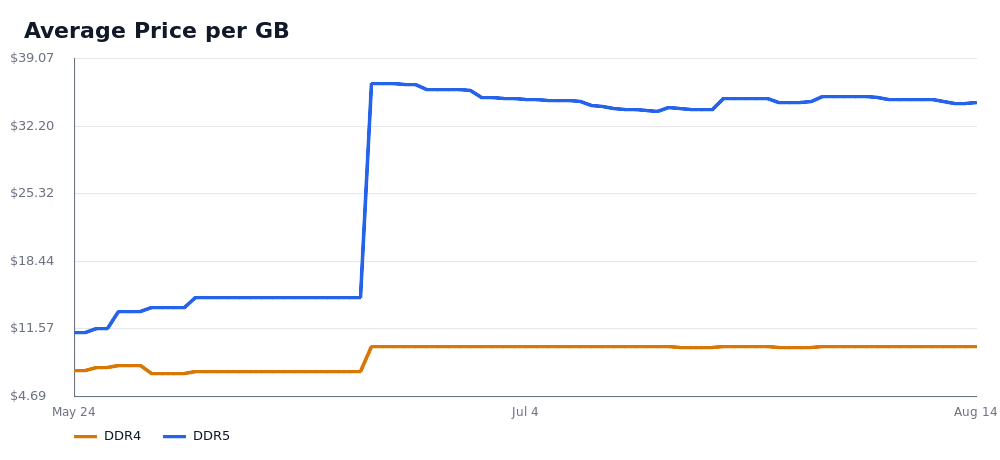
Looking at the market more broadly, the average price per gigabyte for new DDR5 RAM increased from $11.17 per GB on May 24 to $34.61 per GB on August 14.
That's an increase of approximately 209.8% in less than three months.
DDR5 reached its highest average price per GB of the period on June 20, when it hit $36.53. Prices eased somewhat after that spike, spending much of July and August in the $34–$35-per-GB range.
DDR4 moved in the same direction, but nowhere near as aggressively.
The average price of new DDR4 RAM increased from $7.34 per GB to $9.76 per GB, a 32.9% increase. DDR4 briefly reached $9.82 per GB in early August before settling slightly lower.
For anyone comparing DDR4 vs. DDR5 prices in 2026, the difference in price movement is arguably more important than the absolute numbers. DDR4 has become more expensive, but DDR5 has experienced a much more dramatic shift.
64GB DDR5 Prices Have Seen the Biggest Increase
Anyone searching for a 64GB DDR5 kit is seeing the most dramatic price movement in our data.
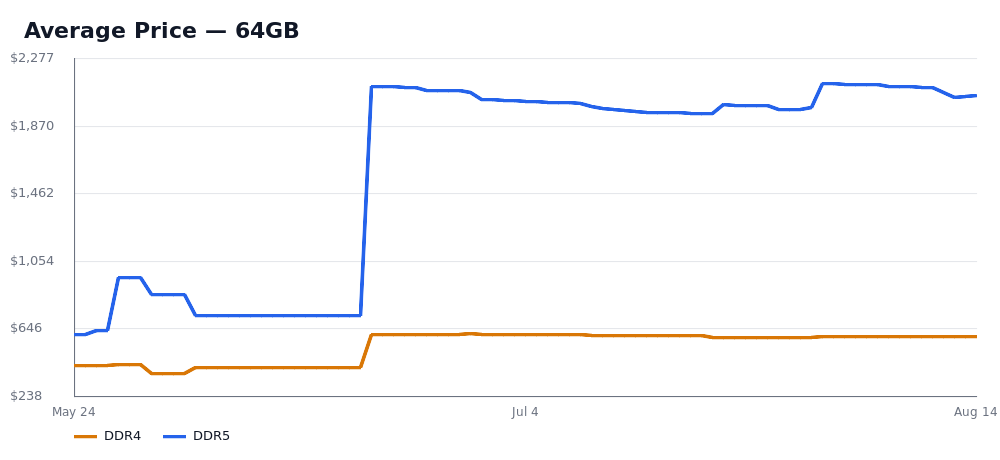
The average price of 64GB DDR5 RAM started the period at $614.74. By August 14, the average had reached $2,054.99.
That's an increase of $1,440.25, or 234.3%.
The average 64GB DDR5 price actually peaked even higher at $2,126.28 on July 31.
That makes 64GB one of the clearest examples of how much the DDR5 market has changed over the summer.
This capacity is increasingly attractive for high-end gaming PCs, workstation builds, software development, virtualization, content creation, AI workloads, and other memory-heavy applications. Unfortunately, buyers shopping for 64GB DDR5 RAM in 2026 are currently paying a substantial premium compared with prices seen only a few months ago.
DDR4 hasn't escaped the increases either.
Average 64GB DDR4 RAM prices moved from $426.02 in late May to $599.59 in mid-August—a 40.7% increase.
That's significant, but it's still nowhere near the 234% increase recorded for 64GB DDR5.
48GB DDR5 RAM Prices Remain Elevated
The growing popularity of 24GB DIMMs has made 48GB DDR5 kits an increasingly interesting middle ground for buyers who need more than 32GB but don't necessarily need 64GB.
Pricing hasn't been especially friendly, though.
Our average 48GB DDR5 price began at $754.00 and ended at $1,342.35, an increase of 78.0%.
The most dramatic part of the movement occurred in June. After reaching a low of $615.13 on June 4, the average price jumped to a high of $1,447.47 on June 20.
Prices gradually declined through the second half of June and July, eventually reaching the $1,270–$1,300 range near the end of July. They then moved higher again as August began.
For buyers specifically searching for 48GB DDR5 RAM, the good news is that prices are below their June peak. The bad news is that they remain considerably higher than they were at the beginning of the tracking period.
Interestingly, 48GB DDR4 pricing was almost completely flat during the shorter period for which we have data. The average moved from $540.49 on June 20 to $542.04 on August 14, an increase of just 0.3%.
32GB DDR5 Prices More Than Doubled
For many desktop PCs, 32GB of RAM has become the sweet spot between affordability and having enough memory for modern multitasking, gaming, development, and productivity workloads.
Unfortunately, 32GB DDR5 prices haven't been immune to the larger DDR5 trend.
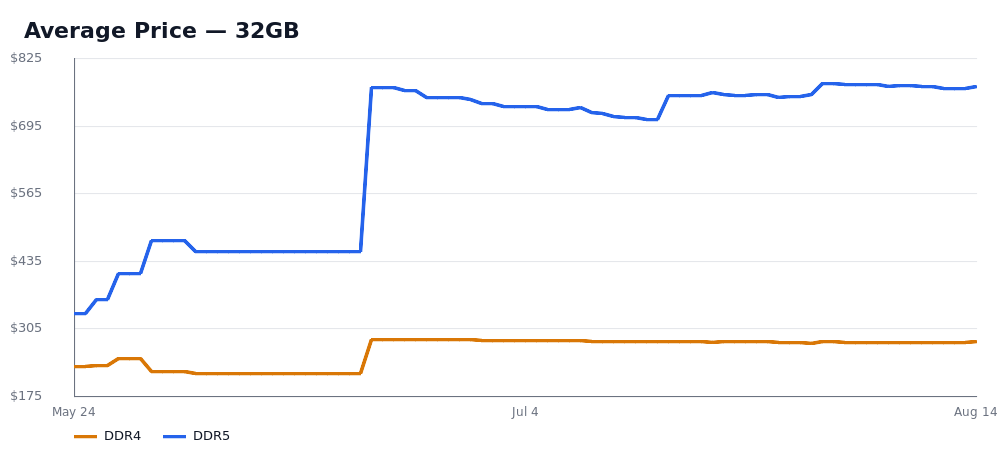
The average price of a 32GB DDR5 kit increased from $334.03 to $770.35, a jump of 130.6%.
Prices reached $768.65 by June 20 and remained elevated throughout most of July. The average briefly peaked at $776.73 on August 1 before settling back slightly.
That means someone researching a 32GB DDR5 RAM upgrade today is looking at an average market price more than twice as high as it was in late May according to our tracked listings.
32GB DDR4 Prices Have Been Much More Stable
The situation is considerably less extreme for 32GB DDR4 RAM.
Average prices increased from $233.73 to $280.03, representing a 19.8% increase.
The average peaked at $285.15 on June 20 and has remained around $278–$283 through much of July and August.
For PCs that still support DDR4, the numbers reinforce one of the platform's remaining advantages: 32GB DDR4 is experiencing significantly less price pressure than 32GB DDR5.
Of course, DDR4 and DDR5 aren't interchangeable—you need the memory standard supported by your motherboard and processor—but buyers deciding between complete DDR4 and DDR5 platform builds may want to factor current memory pricing into the total system cost.
Even 16GB DDR5 RAM Has Doubled in Price
Entry-level and mainstream memory configurations are seeing the same trend.
Average 16GB DDR5 RAM prices increased from $186.68 in May to $377.04 in August, an increase of approximately 102%.
Prices peaked at $378.49 on June 20, meaning the current average is essentially back near the highest point we've recorded during the entire period.
By comparison, 16GB DDR4 increased only 17.5%, moving from $122.01 to $143.36.
That gap illustrates just how different the DDR4 and DDR5 markets have behaved over the last several months.
Average RAM Prices and the Cheapest RAM Prices Tell Different Stories
One particularly interesting part of the data is the difference between average RAM prices and the cheapest available RAM listings.
While the average price per GB of DDR5 increased sharply, the cheapest tracked DDR5 price per GB actually fell.
The lowest available DDR5 price started at $4.57 per GB in late May, briefly dropped as low as $0.84 per GB in June and July, and ended the period at $2.19 per GB.
In other words, the cheapest DDR5 price per GB fell 52.2% even while average DDR5 pricing climbed more than 200%.
That's an important distinction for bargain hunters.
Average pricing tells us what the broader collection of available products looks like, while the lowest-price metric can be heavily influenced by a relatively small number of unusually inexpensive listings.
The DDR4 market showed the opposite trend. Its cheapest available price increased from $0.59 per GB to $1.25 per GB by August 14, although DDR4 briefly reached a low of $0.42 per GB on July 30.
The takeaway is simple: there can still be DDR5 deals even when the overall DDR5 market is expensive. Buyers willing to compare individual listings may see a very different picture than someone simply looking at the overall average.
Used DDR4 Could Be Worth Watching
The used-memory market produced another interesting split.
Average used DDR5 pricing increased 30.4%, rising from $11.96 per GB to $15.59 per GB.
Used DDR4 moved in the opposite direction.
The average price of used DDR4 fell from $8.06 per GB to $6.97 per GB, a decline of 13.5% over the period.
That doesn't automatically make every used DDR4 listing a good deal, but it does suggest that shoppers trying to extend the useful life of an existing DDR4 system may have more opportunities in the secondary market than buyers searching for used DDR5.
Is Now a Good Time to Buy DDR5 RAM?
Based strictly on the last three months of price data, it's difficult to call the current DDR5 market inexpensive.
Average prices are substantially higher than they were in May across every DDR5 capacity we're tracking.
The size of the increases is especially striking: 16GB DDR5 is up 102%, 32GB DDR5 is up 131%, 48GB DDR5 is up 78%, and 64GB DDR5 is up 234%.
However, the lowest available DDR5 price per GB paints a more nuanced picture. Bargains are still appearing even though average prices remain elevated.
If you need RAM immediately, comparing individual kits rather than relying on typical market pricing could therefore be especially important right now.
If your upgrade isn't urgent, watching the price trend may be worthwhile—particularly for 64GB DDR5 and 48GB DDR5, where relatively small percentage changes can translate into substantial differences in total cost.
Is DDR4 Still a Better Value in 2026?
For systems that can use it, DDR4 pricing has been significantly more stable than DDR5 during this period.
That doesn't mean DDR4 prices are falling. Most new DDR4 categories we track are actually more expensive than they were in May.
But the increases have been much smaller.
A 32GB DDR4 kit rose 19.8%, compared with 130.6% for 32GB DDR5. A 64GB DDR4 kit rose 40.7%, compared with 234.3% for 64GB DDR5.
For anyone maintaining an existing DDR4 workstation, gaming PC, home server, or older desktop, adding memory may therefore still make financial sense compared with replacing the entire platform simply to move to DDR5.
What We're Watching Next
The next several weeks should tell us whether the recent DDR5 pricing plateau is becoming a longer-term trend or simply a pause after the sharp increases recorded during June.
There are already some hints of stabilization in certain capacities.
64GB DDR5, for example, ended August 14 at $2,054.99—below its July 31 peak of $2,126.28. Likewise, 48GB DDR5 remains below its June high of $1,447.47.
But neither category has returned anywhere close to its late-May pricing.
DDR4 appears much steadier, with several capacities trading in relatively narrow ranges through July and early August.
We'll continue tracking DDR5 RAM prices, DDR4 RAM prices, price per GB, used RAM prices, and popular memory capacities including 16GB, 32GB, 48GB, and 64GB kits to see where the market moves next.
Bottom Line: DDR5 RAM Prices Are the Story of the Summer
The last three months have produced a clear divide in the memory market.
DDR4 RAM has become somewhat more expensive, but DDR5 RAM prices have risen dramatically, particularly for larger-capacity kits.
For shoppers, the most notable changes are in 32GB DDR5, 48GB DDR5, and especially 64GB DDR5. Meanwhile, 32GB DDR4 and 64GB DDR4 have experienced much smaller increases, and used DDR4 pricing has actually declined.
Perhaps the most important lesson from the data is that headline averages don't tell the entire story. Even with DDR5 averages significantly higher than they were three months ago, the cheapest available DDR5 listings remain much less expensive than the overall market.
Whether you're building a new PC, upgrading a workstation, adding memory to a home server, or simply waiting for the right deal, this is a market where tracking RAM prices over time matters more than ever.