Anyone who has priced out a new PC build lately has probably had the same reaction: what happened to RAM prices?
Memory was one of the easier parts of a computer build to budget for not that long ago. In July 2026, that is no longer the case. DDR5 prices remain elevated, DDR4 is not providing as much of a discount as buyers might expect, and high-capacity kits—especially 48GB and 64GB RAM configurations—have become noticeably more expensive.
Our latest RAM charts track daily pricing from June 6 through July 16, 2026. The data covers new listings from Newegg, eBay, Walmart and Best Buy, with Amazon currently excluded. Used RAM is tracked separately. Because the charts include thousands of products across different brands, speeds, timings and module types, the average figures describe the overall market rather than the price of one typical gaming kit.
RAM prices jumped sharply in late June
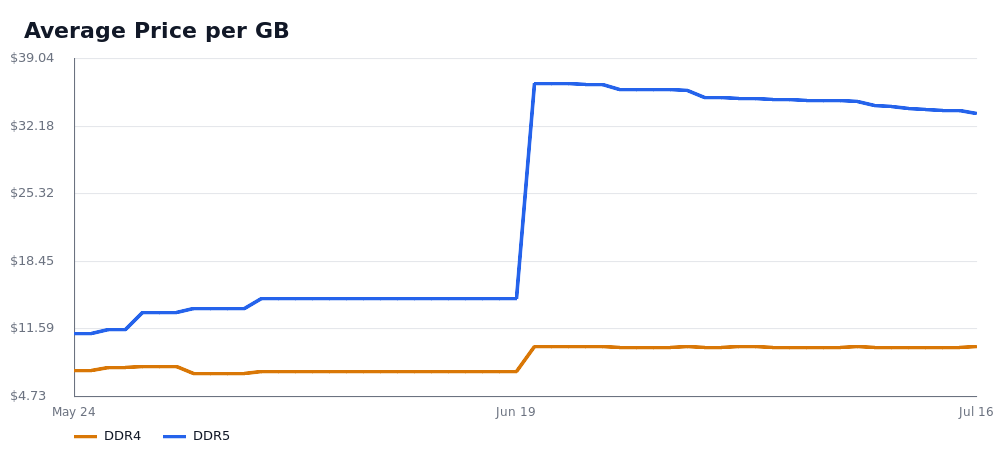
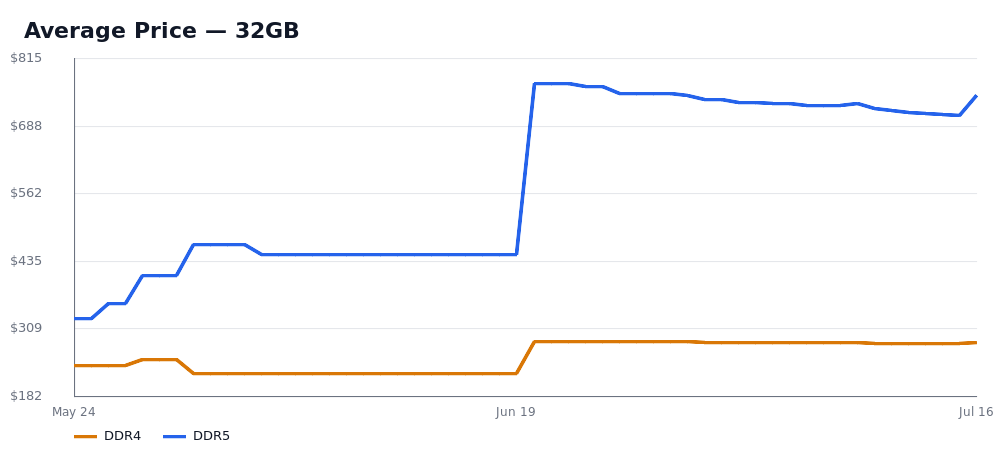
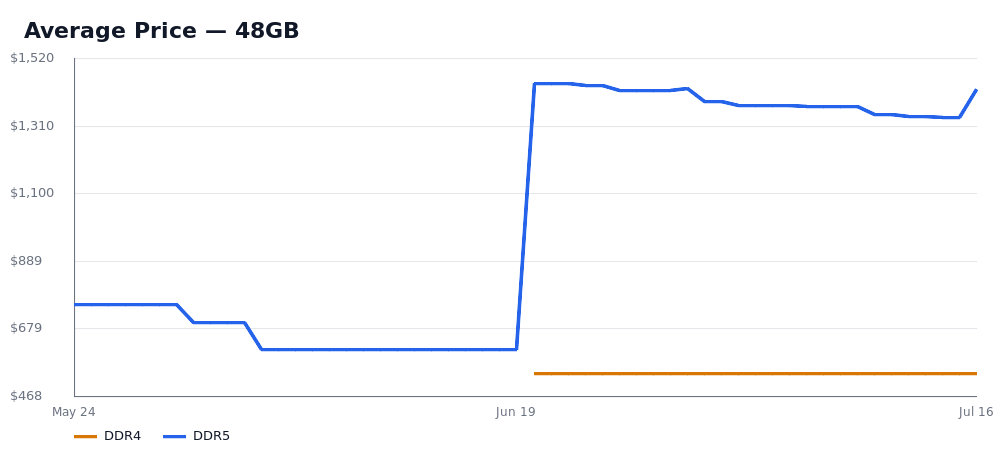
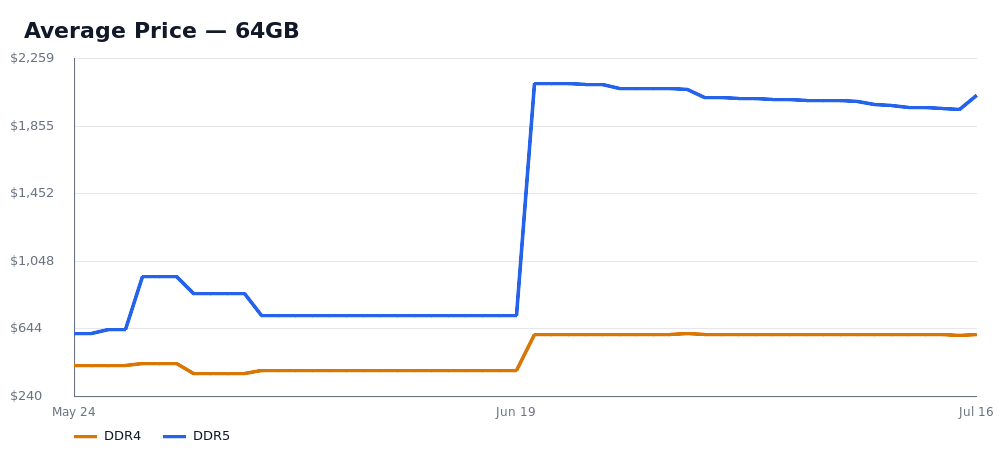
The most obvious feature in nearly every RAM chart is the sudden change around June 20.
Before that point, the average price of new DDR5 memory was approximately $14.65 per GB. It then jumped to a high of $36.50 per GB, before gradually declining to $33.46 per GB on July 16.
That leaves the average DDR5 price per gigabyte up 128.4% over the 41-day tracking period.
DDR4 prices followed the same general pattern, although the increase was less extreme. Average DDR4 pricing moved from $7.24 per GB to $9.78 per GB, an increase of 35.1%.
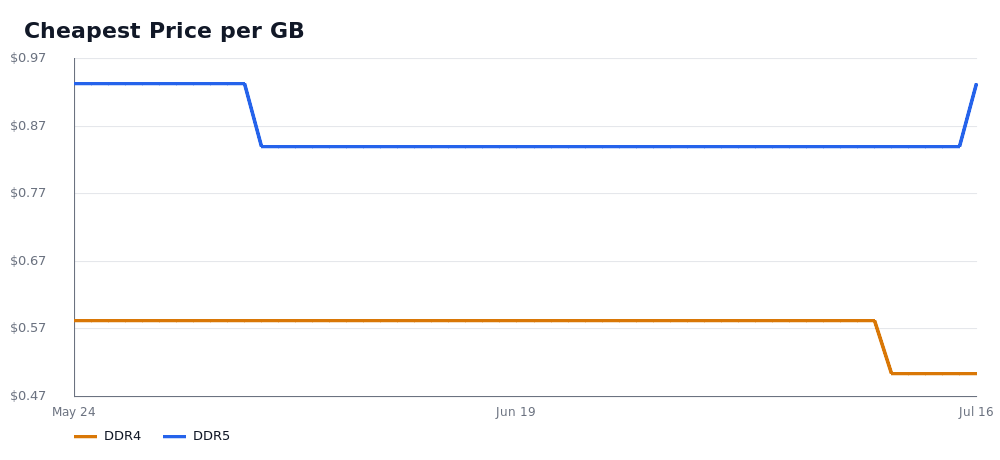
RAM price changes from June 6 through July 16, 2026RAM market measurementJune 6July 16ChangeAverage DDR5 price per GB$14.65$33.46+128.4%Average DDR4 price per GB$7.24$9.78+35.1%Cheapest DDR5 price per GB$0.84$0.94+10.9%Cheapest DDR4 price per GB$0.59$0.51−13.3%
The difference between the average price and the cheapest available price is important.
While average DDR5 pricing more than doubled, the lowest available DDR5 price increased by only about 11%, from $0.84 to $0.94 per GB. The cheapest DDR4 price actually declined from $0.59 to $0.51 per GB.
That does not mean ordinary shoppers can buy every kind of RAM for less than a dollar per gigabyte. The cheapest listings may involve unusual module sizes, slower memory, clearance inventory or products that are not appropriate for every desktop. However, the gap suggests that the market has not moved uniformly.
In plain English: affordable RAM still exists, but there is less of it, and the broader pool of available products has become much more expensive.
What the DDR5 price charts are showing
DDR5 remains the center of the current RAM market.
It is the standard choice for current-generation desktop platforms, new gaming PCs, workstations and many servers. That puts DDR5 under pressure from several directions at once. Consumer PC builders need it, system manufacturers need it, and data-center operators are buying enormous quantities of both conventional DDR5 and specialized high-bandwidth memory.
Our DDR5 price charts show a market that surged quickly and has since given back only a small portion of those gains.
The average DDR5 price per GB reached $36.50 on June 20. It then moved downward almost every week, reaching $33.46 by July 16. That is a decline of roughly 8% from the peak, but prices remain more than twice as high as they were at the beginning of the tracking window.
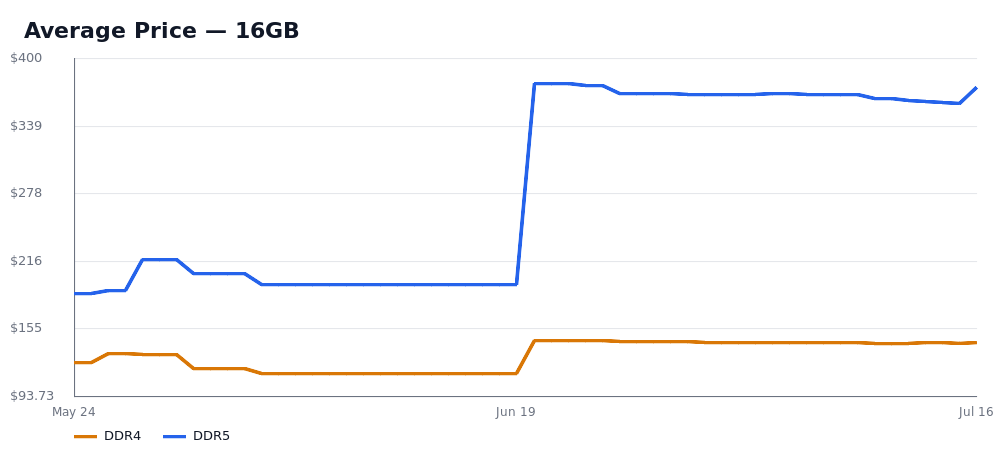
The same pattern appears in the kit-size charts:
- Average 16GB DDR5 pricing rose from $195.14 to $373.46.
- Average 32GB DDR5 pricing rose from $447.88 to $745.69.
- Average 48GB DDR5 pricing rose from $615.13 to $1,423.57.
- Average 64GB DDR5 pricing rose from $725.37 to $2,035.90.
These figures should not be read as the price every buyer will pay for a mainstream kit. They are averages across a broad product catalog and may include expensive specialty memory, high-speed enthusiast kits, premium designs and unusually priced listings.
They are still useful, however, because they show how dramatically the overall DDR5 marketplace has shifted.
64GB RAM has been hit especially hard
The 64GB RAM market produced the largest percentage increase in the dataset.
Average pricing for a new 64GB DDR5 kit climbed from $725.37 on June 6 to $2,035.90 on July 16, an increase of 180.7%. The category briefly reached an average high of $2,109.81 on June 20.
DDR4 was less volatile, but 64GB DDR4 pricing also rose sharply. Its average increased from $393.94 to $612.01, or 55.4%.
Again, these are broad market averages—not a claim that a normal 2x32GB desktop kit necessarily costs $2,000. The extreme movement probably reflects a combination of actual memory inflation and changes in which products remained available in the tracked catalog.
When lower-cost 64GB products go out of stock, even temporarily, expensive workstation, enthusiast and specialty modules make up a larger share of the remaining listings. That can pull the average sharply upward without every individual product increasing by the same percentage.
For anyone shopping for 64GB RAM, the lesson is to compare actual kits rather than relying solely on a market-wide average. Check the total capacity, module count, memory speed, latency, voltage, whether the kit supports XMP or EXPO, and whether it appears on the motherboard manufacturer’s compatibility list.
The 64GB category is currently too distorted for buyers to assume that the first listing they find represents a fair market price.
DDR4 prices are not behaving like an obsolete technology
Normally, buyers expect an older memory generation to become steadily cheaper as the market moves on. DDR4 is complicating that assumption.
The lowest DDR4 price in our data remains very competitive. At $0.51 per GB, it is cheaper than it was at the beginning of June. That makes DDR4 attractive for budget upgrades, home servers and older systems that already have a compatible motherboard and processor.
The broader DDR4 market is moving in the opposite direction, though.
Average DDR4 pricing increased 35.1% per gigabyte during the tracking window. Average 16GB and 32GB kit prices rose by approximately 24% and 25%, respectively. Average 64GB DDR4 pricing increased more than 55%.
This split is likely to be frustrating for buyers. There may still be excellent individual DDR4 deals, but the market as a whole is not following the smooth downward curve normally associated with aging PC hardware.
TrendForce reported in June that DDR4 supply was tight enough to push some buyers toward even older DDR3 products. Its July spot-market updates continued to describe limited supply, sellers reluctant to release inventory and prices maintaining an upward trend. Read the TrendForce memory spot-price update .
In other words, DDR4 may be old, but it is not necessarily abundant.
Used RAM is not offering consistent relief
The used-memory market is also sending mixed signals.
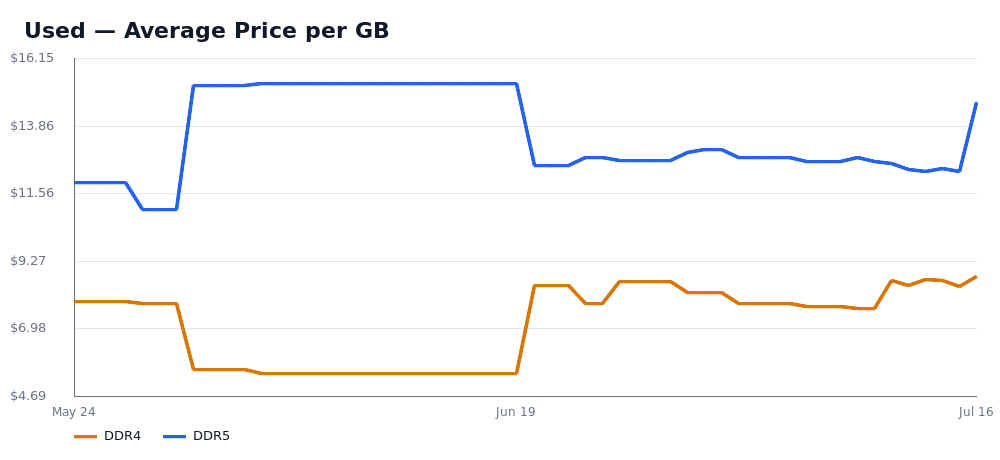
Average used DDR5 pricing fell modestly over the tracking period, moving from $15.30 to $14.67 per GB. It reached a low of $12.31 per GB on July 15 before jumping again the following day.
Used DDR4 went the other way. Its average price increased from $5.48 to $8.76 per GB, a gain of 60%.
The number of tracked used listings is much smaller than the new-product sample, so these averages can move quickly when the product mix changes. Approximately 246 used DDR5 products and 492 used DDR4 products were tracked per day, compared with thousands of new listings.
Used RAM can still be worth considering, particularly for DDR4 systems, but the discount should be meaningful. Memory modules are generally durable, yet buyers should still confirm that the seller accepts returns and that the kit has passed an extended memory test.
A used kit priced only slightly below a new one is difficult to justify.
Is now a bad time to buy RAM?
It depends on how urgently you need it.
For a working computer that already has enough memory, there is a reasonable argument for waiting and watching the RAM charts. Average DDR5 prices have eased from their June peak, and weaker consumer demand may create periodic sales or inventory-clearing opportunities.
For a system that genuinely needs more memory, trying to predict the exact bottom may not be worthwhile. The market outlook does not currently point to a rapid return to the unusually cheap RAM prices seen in earlier cycles.
A few practical rules can reduce the damage:
- Compare the final kit price rather than the market-wide average.
- Track price per gigabyte within the capacity and speed you actually need.
- Avoid paying a large premium for memory speeds your processor or workload cannot use.
- Check both 2x24GB and 2x32GB options when shopping around the 48GB-to-64GB range.
- Consider DDR4 only when you already own a DDR4 platform. Buying an older motherboard solely to save on memory may create a poor overall value.
- Be cautious with marketplace listings that use stock images, incomplete specifications or unclear warranty terms.
The cheapest DDR5 and DDR4 listings have moved far less than the overall averages, so patient shoppers can still find deals. They may simply need to look harder and act faster when reputable inventory appears.
When will RAM prices come back down?
The uncomfortable answer is that most current industry forecasts do not predict a broad RAM price collapse during the remainder of 2026.
TrendForce expects server DRAM contract prices to rise another 13% to 18% quarter over quarter in the third quarter of 2026. It also expects server DRAM prices to continue rising quarterly from the second half of 2026 through the second half of 2027, although the pace of increase may slow. Read the TrendForce third-quarter 2026 DRAM forecast .
Consumer RAM and server memory are not the same market, and retail prices do not move in perfect lockstep with server contracts. But they draw on the same limited manufacturing base. When memory producers prioritize HBM, server DDR5 and other high-margin products, less capacity is available to quickly flood the desktop market with cheap modules.
Micron’s June 2026 outlook is even less encouraging for anyone waiting for a quick return to normal. The company says DRAM and NAND demand continues to exceed supply and expects tight conditions to persist beyond calendar 2027. Micron anticipates gradual industry-supply improvement in 2028, but says it still cannot identify when supply will fully catch up with growing demand. Read Micron’s June 2026 outlook .
Based on those forecasts, the most realistic near-term outcome is slower price increases and occasional retail pullbacks, rather than a return to the low RAM prices buyers remember. Weak PC demand, aggressive retailer promotions or a temporary inventory correction could produce better deals in late 2026 or during 2027, particularly for specific DDR5 kits.
A sustained, market-wide decline looks more likely to require meaningful new manufacturing capacity, weaker AI infrastructure demand, or both. Current production timelines suggest that 2028 is the earliest plausible window for broad supply relief, and even that is not guaranteed.
For now, buyers should expect RAM prices to remain volatile. The worst of the sudden jump may be behind us, but the data and current industry forecasts do not yet show that the memory shortage—or the pricing pressure that comes with it—is over.